60S ribosomal protein L10a
60S ribosomal protein L10a is a protein that in humans is encoded by the RPL10A gene.
Quick Facts RPL10A, Available structures ...
| RPL10A |
|---|
|
| Available structures |
|---|
| PDB | Ortholog search: PDBe RCSB |
|---|
| List of PDB id codes |
|---|
4UG0, 4V6X, 5AJ0, 3J7R |
|
|
| Identifiers |
|---|
| Aliases | RPL10A, CSA19, Csa-19, L10A, NEDD6, ribosomal protein L10a, uL1 |
|---|
| External IDs | OMIM: 615660 MGI: 1343877 HomoloGene: 68543 GeneCards: RPL10A |
|---|
| Gene location (Human) |
|---|
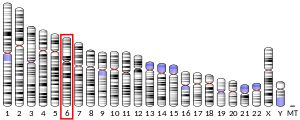 | | Chr. | Chromosome 6 (human) |
|---|
| | Band | 6p21.31 | Start | 35,468,401 bp |
|---|
| End | 35,470,785 bp |
|---|
|
| Gene location (Mouse) |
|---|
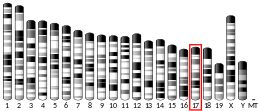 | | Chr. | Chromosome 17 (mouse) |
|---|
| | Band | 17|17 A3.3 | Start | 28,328,471 bp |
|---|
| End | 28,331,033 bp |
|---|
|
| Gene ontology |
|---|
| Molecular function | • structural constituent of ribosome
• GO:0001948 protein binding
• RNA binding
|
|---|
| Cellular component | • cytosol
• ribosome
• membrane
• focal adhesion
• large ribosomal subunit
• extracellular exosome
• nucleus
• cytosolic large ribosomal subunit
• GO:0097483, GO:0097481 postsynaptic density
• polysomal ribosome
|
|---|
| Biological process | • viral transcription
• SRP-dependent cotranslational protein targeting to membrane
• translational initiation
• nuclear-transcribed mRNA catabolic process, nonsense-mediated decay
• maturation of LSU-rRNA
• protein biosynthesis
• rRNA processing
• response to ethanol
• cytoplasmic translation
|
|---|
| Sources:Amigo / QuickGO |
|
| Orthologs |
|---|
| Species | Human | Mouse |
|---|
| Entrez | | |
|---|
| Ensembl | | |
|---|
| UniProt | | |
|---|
| RefSeq (mRNA) | | |
|---|
| RefSeq (protein) | | |
|---|
| Location (UCSC) | Chr 6: 35.47 – 35.47 Mb | Chr 17: 28.33 – 28.33 Mb |
|---|
| PubMed search | | |
|---|
Ribosomes, the organelles that catalyze protein synthesis, consist of a small 40S subunit and a large 60S subunit. Together these subunits are composed of 4 RNA species and approximately 80 structurally distinct proteins. This gene encodes a ribosomal protein that is a component of the 60S subunit. The protein belongs to the L1P family of ribosomal proteins. It is located in the cytoplasm. The expression of this gene is downregulated in the thymus by cyclosporin-A (CsA), an immunosuppressive drug. Studies in mice have shown that the expression of the ribosomal protein L10a gene is downregulated in neural precursor cells during development. This gene used to be referred to as NEDD6 (neural precursor cell expressed, developmentally downregulated 6), but it has been renamed RPL10A (ribosomal protein 10a). As is typical for genes encoding ribosomal proteins, there are multiple processed pseudogenes of this gene dispersed through the genome.
Further reading
- Wool IG, Chan YL, Glück A (1996). "Structure and evolution of mammalian ribosomal proteins". Biochem. Cell Biol. 73 (11–12): 933–47. doi:10.1139/o95-101. PMID 8722009.
- Cross SH, Charlton JA, Nan X, Bird AP (1994). "Purification of CpG islands using a methylated DNA binding column". Nat. Genet. 6 (3): 236–44. doi:10.1038/ng0394-236. PMID 8012384. S2CID 12847618.
- Olvera J, Wool IG (1996). "The primary structure of rat ribosomal protein L10a". Biochem. Biophys. Res. Commun. 220 (3): 954–7. doi:10.1006/bbrc.1996.0513. PMID 8607874.
- Kenmochi N, Kawaguchi T, Rozen S, et al. (1998). "A map of 75 human ribosomal protein genes". Genome Res. 8 (5): 509–23. doi:10.1101/gr.8.5.509. PMID 9582194.
- Andersen JS, Lyon CE, Fox AH, et al. (2002). "Directed proteomic analysis of the human nucleolus". Curr. Biol. 12 (1): 1–11. doi:10.1016/S0960-9822(01)00650-9. PMID 11790298. S2CID 14132033.
- Strausberg RL, Feingold EA, Grouse LH, et al. (2003). "Generation and initial analysis of more than 15,000 full-length human and mouse cDNA sequences". Proc. Natl. Acad. Sci. U.S.A. 99 (26): 16899–903. doi:10.1073/pnas.242603899. PMC 139241. PMID 12477932.
- Koga M, Shichijo S, Yamada A, et al. (2004). "Identification of ribosomal proteins S2 and L10a as tumor antigens recognized by HLA-A26-restricted CTL". Tissue Antigens. 61 (2): 136–45. doi:10.1046/j.0001-2815.2002.00009.x. PMID 12694581.
- Odintsova TI, Müller EC, Ivanov AV, et al. (2004). "Characterization and analysis of posttranslational modifications of the human large cytoplasmic ribosomal subunit proteins by mass spectrometry and Edman sequencing". J. Protein Chem. 22 (3): 249–58. doi:10.1023/A:1025068419698. PMID 12962325. S2CID 10710245.
- Mungall AJ, Palmer SA, Sims SK, et al. (2003). "The DNA sequence and analysis of human chromosome 6". Nature. 425 (6960): 805–11. Bibcode:2003Natur.425..805M. doi:10.1038/nature02055. PMID 14574404.
- Bouwmeester T, Bauch A, Ruffner H, et al. (2004). "A physical and functional map of the human TNF-alpha/NF-kappa B signal transduction pathway". Nat. Cell Biol. 6 (2): 97–105. doi:10.1038/ncb1086. PMID 14743216. S2CID 11683986.
- Suzuki Y, Yamashita R, Shirota M, et al. (2004). "Sequence comparison of human and mouse genes reveals a homologous block structure in the promoter regions". Genome Res. 14 (9): 1711–8. doi:10.1101/gr.2435604. PMC 515316. PMID 15342556.
- Gerhard DS, Wagner L, Feingold EA, et al. (2004). "The status, quality, and expansion of the NIH full-length cDNA project: the Mammalian Gene Collection (MGC)". Genome Res. 14 (10B): 2121–7. doi:10.1101/gr.2596504. PMC 528928. PMID 15489334.
- Andersen JS, Lam YW, Leung AK, et al. (2005). "Nucleolar proteome dynamics". Nature. 433 (7021): 77–83. Bibcode:2005Natur.433...77A. doi:10.1038/nature03207. PMID 15635413. S2CID 4344740.






Comments
Post a Comment